










6 October 2026
Latest News
Why is oversupply (still) occurring?
It ought to be noted that about ten years ago, ACA and ACA NSW may be the very first to identify oversupply of early childhood education and care services and their negative consequences as early as 2016/2017.
And with the Federal Minister for Education (the Hon Jason Clare MP) on 8 May 2026 announcing the proposed national Early Education & Care Commission to address oversupply (amongst other possible responsibilities), it confirms that oversupply is very much a real and present danger, not only as 40% or more in increased fees to parents, but also the operational viability of services.
Yet, government-led new supply of services funded by taxpayers (eg at a cost of $147,500 per place) begs the question - "why is oversupply continuing and potentially exacerbated by governments"?
The Law of Supply and Demand in Economics is broadly assumed by far too many that if only supply of early childhood education and care services were to increase substantially enough, fees will decrease.
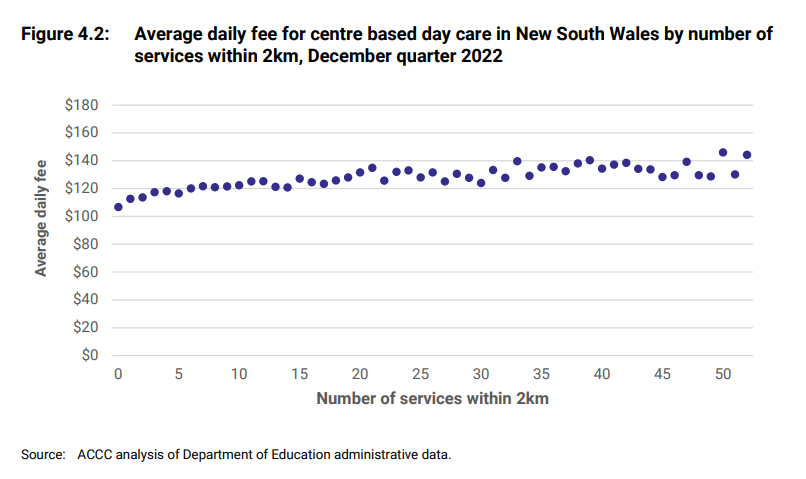
ACA and ACA NSW have long advocated that this does not occur. And more importantly, the Australian Competition and Consumer Commission (ACCC) published its June 2023 interim report proving instead that fees increase as the supply of services increase.
Sadly, in Australia and especially in NSW, oversupply appears to be structurally entrenched unless governments change its laws and policies. The three main contributors NSW are:
NATIONAL COMPETITION POLICY
Implemented since 1995, all governments are obligated to implement the National Competition Policy in all Australian states and territories. This is on the assumption that by increasing competition, superior outcomes will occur and benefit Australians.
NSW STATE ENVIRONMENTAL PLANNING POLICY (SEPP)
First introduced as the NSW State Environmental Planning Policy (Educational Establishments and Child Care Facilities) 2017 by the then NSW Government, the current law is the NSW State Environmental Planning Policy State Environmental Planning Policy (Transport and Infrastructure) 2021 (also known as the SEPP).
This NSW SEPP literally removed all planning and approval powers from all NSW local councils other than car parking. And the SEPP's legal requirement on NSW local councils only need to seek concurrence from the NSW Regulatory Authority (ie their confirmation the service is of an Approved Provider and complies with the number of approved places).
NSW DEPARTMENT OF EDUCATION'S ASSESSMENT PANEL DECISION MAKING FRAMEWORK
To fulfil the current NSW Governnment's 100+50 new preschools on school grounds, their process for site selections uses its Assessment Panel Decision Making Framework.
And although availability of existing early childhood education and care places is a factor, one can only conclude that the NSW Government must also be using the local children's outcomes based on the Australian Early Development Census to trump existing supply.
It is obvious to ACA NSW that the NSW Government does not have any confidence in Quality Ratings given:
recent revelations that 66.6% of sampled Exceeding rated services were also considered High Risk or Very High Risk); and
Until the Federal Government and the NSW Government address the above, oversupply will continue, thus contriubuting to lose-lose outcomes for children and existing early childhood education and care services.
For any further information/clarification, members can contact ACA NSW on 1300 556 330 or nsw@childcarealliance.org.au.
PUBLISHED: 28 MAY 2026