








- Home
- Latest News
- About Us
- Membership
- Events
- Services
- Suppliers
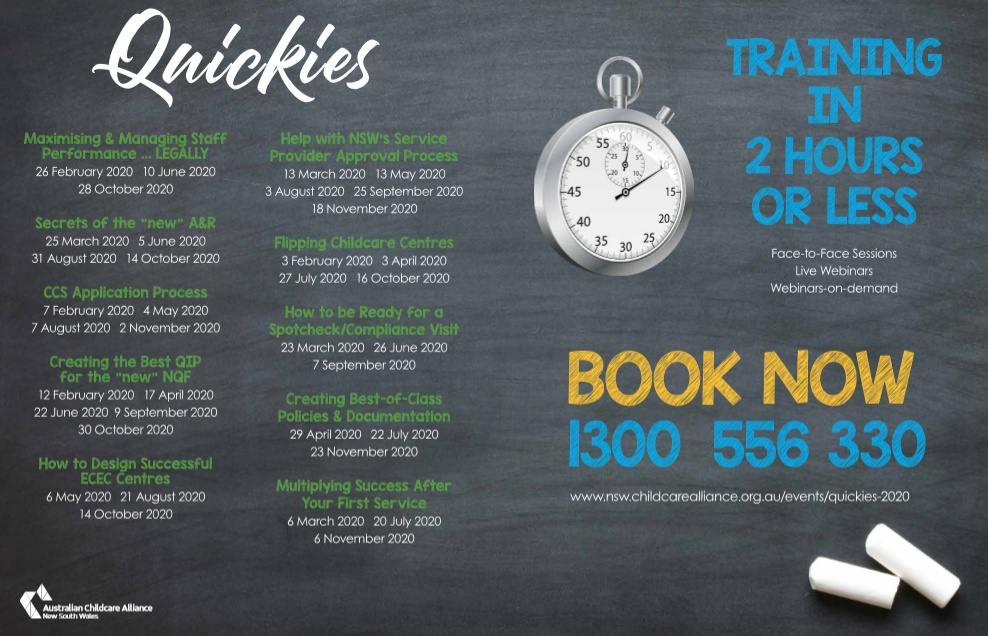
Training in 2 hours or less! (Face-to-face sessions, Live webinars and Webinars-on-demand)
Maximising & Managing Staff Performance ... LEGALLY
Secrets of the "new" A&R
CCS Application Process
Creating the best QIP for the "new" A&R
How to Design Successful Early Childhood Education and Care Centres
Help with NSW's Service Provider Approval Process
Flipping Childcare Centres
How to be Ready for a Spotcheck/Compliance Visit
Creating Best-of-Class Policies & Documentation
Multiplying Success After Your First Service

1. Do employees need to serve additional notice periods when converting from casual employment to part-time/full-time employment?
As a casual employee, the period of service served can count towards the minimum employment period (probation period) if the employee was on a regular and systematic basis; and if the casual employee has reasonable expectation of ongoing employment on a regular and systematic basis.
The Fair Work Act 2009 s.384(2) also sets out the above information.
2. What is employment on a regular and systematic basis?
This is where a clear pattern or roster of hours shows a repetitive pattern. It does not mean that the hours worked are frequent, often, uniform or constant.
A systematic engagement requires a system, plan or method be established with the frequency of employment during a period of service.
Regular and systematic employment can also be established where the the employer has offered work at times that the employee has made themselves available. Work can also be offered and accepted regularly enough that it is no longer considered occasional or irregular.
3. What is a period of service for a casual employee?
A period of service is defined as each occasion an employee is engaged in a separate contract of employment. This can be week to week, shift to shift, hour to hour or for any agreed short period.
Employees period of service, rather than period of employment, are considered in cases of unfair dismissal. If you have a written agreement that the employee would serve an additional probation period, when converting to part-time or full-time employment, legally it would have no effect under the Fair Work Act 2009 s.384(2). The employees’ whole period of service would be considered and will count towards the period of continuous service.
Continuous service is established upon the regular and systematic basis of ongoing employment. If either party break the continuous service, they must make it clear to the other party that there will be no further engagements.
Absence for illness or injury does not break a period of continuous service.
More information can be found at:

Receiving a complaint is often an unexpected part of running any business, including a child care or early learning service. No business is immune from receiving a complaint, regardless of how successful it is or how customer focused staff are. There can be a tendency to see a complaint as a personal criticism rather than constructive feedback. However, there can be positive outcomes when the situation is managed appropriately.
Why do people complain?
There are many reasons why parents might complain about an early learning centre and the service they’ve received. Sometimes a complaint will almost be expected following an incident; sometimes it will take you by complete surprise. Understanding why people may complain can assist with managing a complaint if it occurs and potentially reducing the likelihood of further complaints. The following are some of the reasons why people may feel the need to complain.
High expectations – consumer expectations are increasingly high when engaging professional services. This is particularly for early learning services. When a parent leaves their child with a service, they will have understandably high expectations regarding the level of care and supervision that will be provided to their child.
Unrealistic expectations – it is also possible that at times parents may have slightly unrealistic expectations about what they can expect from an early learning service. It’s therefore important that a service assists their parents to be clear and fully informed about the types of care and education they provide to children. Having this information documented and readily available to parents, for example on your website or in brochures provided before children enroll, can be beneficial. Encourage parents to ask questions so that expectations can be discussed and appropriately managed.
Emotional motives – some parents may struggle with separation anxiety as much as their child. Some may even feel a sense of guilt when leaving their child with an educator who is initially a stranger. This level of emotion may contribute to the level of expectation they have regarding the quality of care provided.
To inform and be heard – parents may wish to make a complaint about an incident simply so they are sure you and your staff are aware of what has occurred and how they feel. They may complain so they’re listened to and acknowledged, especially if their child has been impacted. Not all complaints will lead to a formal demand for compensation; sometimes people want to receive information about how the incident is being managed to ensure it doesn’t arise again.
Belief that someone is responsible – when something goes wrong we often try to determine who’s responsible. Sometimes someone is obviously responsible, sometimes it’s hard to determine who’s responsible and other times there is no one person responsible but it’s just an unfortunate set of circumstances. However, if a parent thought something had gone wrong and this might have led to a poor outcome, such as an injury to their child, it’s quite possible they may complain with the intention of holding someone responsible and possibly liable.
The importance of managing complaints
There may sometimes be a temptation to ignore a complaint and hope it’ll just go away. Maybe the parent won’t follow up. Maybe the incident won’t occur again. This is a very short-sighted way to run any business as there are clear benefits to appropriately managing complaints.
Parents would understandably expect to see their complaint dealt with quickly and fairly. When this doesn’t happen it’s possible that further complaints will follow, and the issue or concern could become a much greater one. Complaints may also escalate to other people or organisations, such as your Regulatory Authority.
Managing complaints should be seen as good ‘customer service’. You rely on parents and families to keep your business afloat. When customers are unhappy with a service they can talk with their feet by not returning to the service. Keeping parents happy and satisfied is more likely to see them continue to use your service and recommend you to others.
Complaints can provide an early learning service with an opportunity to review and improve their service. Receiving a complaint may highlight an issue which the service had not been aware of. When investigating and dealing with the complaint, the service may wish to consider a change in a procedure to avoid that issue arising again in the future.
How to manage complaints
It’s advisable that all early learning services have a complaints policy. This means that the service will have an agreed-to process which allows for all complaints to be dealt with in a fair and consistent manner. It also means staff know what to do which is important as managing complaints can be a challenging.
A key aspect in dealing with any complaint is listening to the person. Where possible, make time to sit down in a quiet space and give them time to express their concerns. Make the effort to hear what they have to say and take on board what they have told you. You may not agree with all they are saying, however it helps if you can try to understand the situation from their perspective. You may wish to ask them to document their concerns so you both have an accurate record of the matter. Avoid being defensive or taking the complaint personally as this may inflame the situation.
With low level complaints you may be able to offer a solution there and then. However, this won’t always be the case. With more serious complaints you should provide the person with an assurance that you’ll investigate the matter and get back to them with a response at a later date.
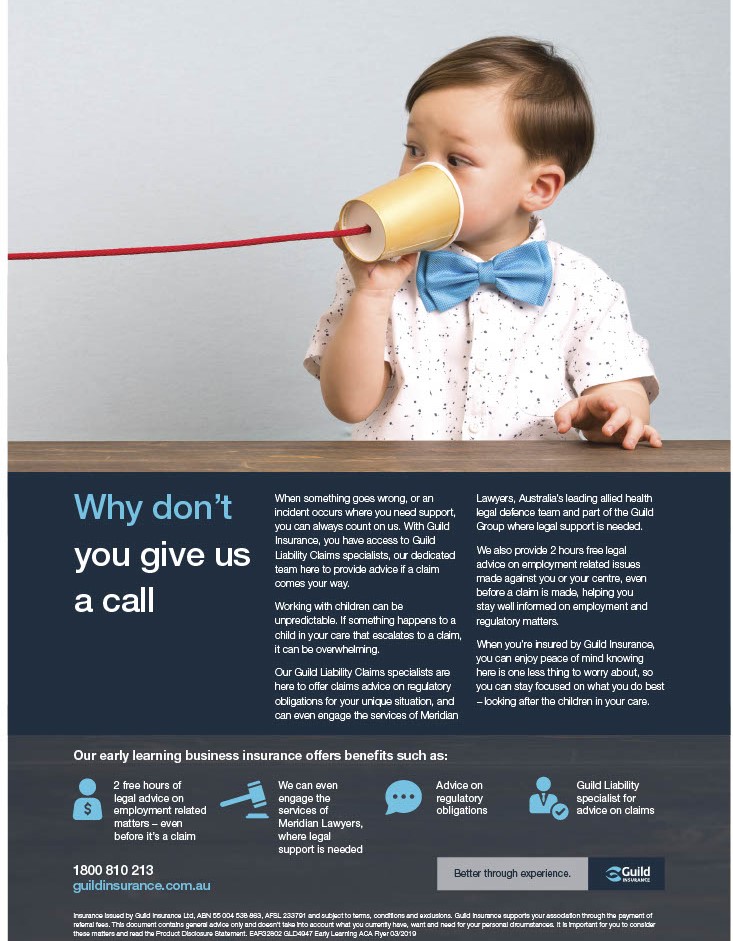
Guild Insurance expects those insured with us not to admit liability (or name someone else as being at fault), or to offer any compensation without contacting us first. Contact Guild Insurance on 1800 810 213 as soon as you’ve received a complaint; don’t wait till it escalates to a claim for compensation. We will provide advice and support to assist you to deal appropriately and professionally with what can be a challenging and possibly upsetting situation. This support can be the difference between sorting a problem quickly and it escalating to a serious claim.
Guild Insurance Limited ABN 55 004 538 863, AFS Licence No. 233 791. This article contains information of a general nature only, and is not intended to constitute the provision of legal advice. Guild Insurance supports your Association through the payment of referral fees for certain products or services you take out with them.