










14 October 2026
Latest News
On 12 May 2026, the Hon Dr Jim Chalmers MP delivered his fifth budget as the Federal Treasurer.
ACA National and ACA NSW are publicly concerned about the lack of certainty regarding wage funding for the early learning workforce in the Federal Government’s 2026–27 Budget. The absence of any funding commitment raises serious concerns about workforce stability across the sector.
No later than by (ideally 1) June 2026, certainty beyond the immediate funding period will be critical to giving providers the confidence they need to plan, invest in their workforce and continue delivering for their communities.
The following provides relevant references and extracts to the early childhood education and care sector, in particular for children and services:
-
CHILD SAFETY
-
“The Government committed $188.5 million over four years from 2025–26 to improve safety and quality in the ECEC sector. This includes a National Educator Register, stronger regulatory coordination and data-sharing, supporting the workforce to complete mandatory child safety training, a national assessment of CCTV in services, and better transparency for parents about the quality and safety of services through upgrades to the Starting Blocks website. The Government is also investing $39.3 million to address gaps in the Working with Children Checks (WWCC) process and implement the National Continuous Checking Capability to provide all jurisdictions near-real time information on the suitability of WWCC holders across the country.”
[SOURCE: Women’s Budget Statement, page 25]
-
-
NEXT STAGE OF THE NATIONAL EARLY CHILDHOOD WORKER REGISTER (AKA NATIONAL REGISTER)
The Australian Government has committed $17.6 million to fund the next stage of development of the National Early Childhood Worker Register (National Register). Subject to agreement by Education Ministers in July, updates will seek to improve the National Register’s functionality, including identity verification, integration with the Family Day Care register, and other system enhancements to help approved providers use the Worker Register. [SOURCE: Federal Department of Education]
-
GENDER-BASED UNDERVALUATION
“The Government has delivered higher wages for women in historically undervalued sectors, investing $17.7 billion and $3.6 billion for pay rises in the female-dominated aged care and child care sectors respectively. The Government continues to support the Fair Work Commission’s Gender Undervaluation – Priority Awards Review, with further decisions expected to be finalised this year.”
[SOURCE: Budget Paper 1, page 40]
-
WORKER RETENTION PAYMENTS
-
“The Government is also working to build a universal Early Childhood Education and Care (ECEC) system, improving affordability and access. The Government is also supporting fair remuneration across the care economy, where women are overrepresented, and has provided $3.6 billion to support a wage increase for the ECEC workforce and committed $17.7 billion to lift wages for aged care workers.”
[SOURCE: Women’s Budget Statement, page 25]
-
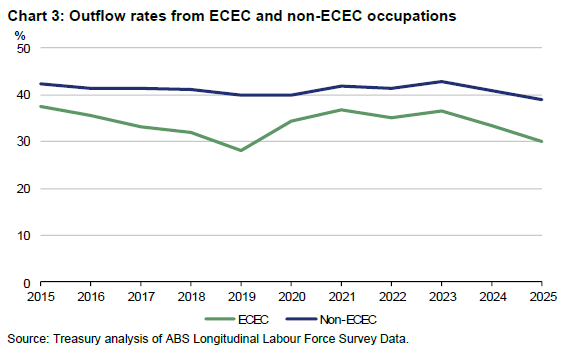
“The aim of the WRP is to retain experienced and qualified early childhood educators and teachers to improve labour supply across the sector. Workers in ECEC occupations have been historically less likely to leave their jobs than workers in non-ECEC occupations, meaning the outflow rate in ECEC is lower. Chart 3 shows that since the increase of ECEC award wages in July 2024 and the additional 10% WRP in December 2024, the outflow rates in ECEC occupations have fallen twice as much as the outflow rates in non-ECEC occupations.”
[SOURCE: Women’s Budget Statement, page 34]
-
-
CHILD CARE SUBSIDY
-
“payments related to the Child Care Subsidy program, which are expected to decrease by $300.8 million in 2026–27 and increase by $805.3 million over the five years to 2029–30, largely reflecting increases to the cost of care due to the Fair Work Commission’s Gender-based undervaluation priority review decision and higher-than-expected indexation, and partially offset by lower-than-expected demand for early childhood education and care.”
[SOURCE: Budget Paper 1, page 102]
-
“Child Care Subsidy payments growth is expected to average 5.4 per cent over the projection period compared to 5.7 per cent at MYEFO. Lower average growth reflects slower growth in usage toward the end of the projection period and follows strong growth between 2025–26 and 2026–27.”
[SOURCE: Budget Paper 1, page 109]2025/2026 $15.6b
2026/2027 $16.9b
2027/2028 $18.6b
2028/2029 $19.9b
2029/2030 $21.1b
[SOURCE: Budget Paper 1, page 221]
-
-
INCLUSION SUPPORT PROGRAM
The Budget also includes an extra $54.8 million in 2026-27 for the Inclusion Support Program to help child care services increase their capacity to support inclusion of children with additional needs. This is in addition to the $59.2 million that was provided last MYEFO. [SOURCE: Federal Department of Education]
-
“The Government will provide $54.8 million in 2026–27 to help early childhood education and care services increase their capacity to support the inclusion of children with additional needs, through tailored support and funding to services.”
2025/2026 -
2026/2027 $54.8m
2027/2028 -
2028/2029 -
2029/2030 -
[SOURCE: Budget Paper 2, page 80]
-
THRIVING KIDS
-
“$139.7 million over five years from 2026–27 to facilitate Thriving Kids services for children in early childhood education and care settings, with funding held in the Contingency Reserve pending consultation and design with states and territories.”
[SOURCE: Budget Paper 2, page 112]
-
-
BUILDING EARLY EDUCATION FUND (BEEF)
-
“The Australian Government’s Building Early Education Fund will build and expand early childhood education and care centres in areas of need, including in the outer suburbs and regional Australia. The Building Early Education Fund includes capital funding to be provided to the states to build and expand services on, or near, school sites.”
[SOURCE: Budget Paper 3, pages 45, 47]
For all states for Non-Gov For NSW
2025/2026 $138.5m $3.9m $3.9m
2026/2027 $97.9m $1.4m $1.4m
2027/2028 $52.8m - -
2028/2029 $28.0m - -
2029/2030 $0.4m - -
“This fund targets areas that are under-served or have relative socioeconomic disadvantage, with 28 projects approved so far, including projects in outer suburbs and regional areas, with more to be added in the future.”
[Women’s Budget Statement, page 33]
-
-
STEM FUNDING
“$0.7 million in 2026–27 to extend Froebel Australia’s Little Scientists program, to provide professional learning for early childhood educators to improve their confidence and ability to introduce STEM concepts in a fun and engaging way to children”
[SOURCE: Budget Paper 2, page 80]
-
PAID PARENTAL LEAVE
“On 1 July 2026, the Australian Government’s Paid Parental Leave scheme will be expanded to six months, with eligible families being $14,000 better off than they would have been in 2022. This builds on the introduction of superannuation contributions on Paid Parental Leave that began in 2025.”
[SOURCE: Budget Paper 1, page 39]
-
LOW-INCOME SUPERANNUATION TAX OFFSET (LISTO)
-
"From 1 July 2027, the Government is boosting the LISTO to provide greater support for low-income workers and help women build their retirement savings. LISTO ensures eligible low-income workers receive a fair tax concession on their superannuation contributions compared to the tax rate on their take-home pay and improves equity between low- and high-income earners. Without LISTO, many low-income workers would receive little or no concessional tax benefit on their contributions. The LISTO income threshold will increase from $37,000 to $45,000, aligning with the top of the second personal income tax bracket. The maximum annual payment will rise to $810, reflecting the increase in the Superannuation Guarantee rate to 12 per cent. These changes were estimated in the 2025–26 MYEFO to result in an increase to administered payments of $435 million over the five years from 2024–25."
[SOURCE: Women’s Budget Statement, page 46]
-
-
SMALL BUSINESS
Making the $20,000 instant asset write-off permanent from July 2026 and a permanent two-year loss carry back for all companies up to $1 billion in turnover.
-
TAXATION
The government is introducing a $1,000 instant tax deduction for work-related expenses.
A minimum 30% tax rate will be introduced on discretionary trust distributions, effective from 2028.
From 1 July 2026, the 16% tax rate on taxable income between $18,201 and $45,000 will fall to 15%.
For any further information/clarification, please contact the ACA NSW team via 1300 556 330 or nsw@childcarealliance.org.au.
PUBLISHED: 13 MAY 2026