








- Home
- Latest News
- About Us
- Membership
- Events
- Services
- Suppliers
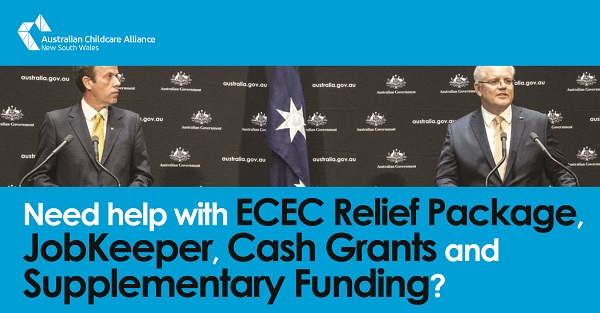
The video of the Australian Childcare Alliance (ACA) NSW Network meeting held on 27 April 2020 is as follows:
The corresponding slides for the above Network Meeting are here.
PUBLISHED: 16 APRIL 2020
Please note that the responses below are correct as at Friday, 17 April 2020. Should any of the detail change, the Australian Childcare Alliance (ACA) will provide further updates.

The key dates are as follows:
Eligible EmployeesOn 1 March 2020 eligible employees are defined as:
There is also a requirement that eligible employees have provided a notice to their employer agreeing to the following:
|
| Q01: Are Company Directors, Trust beneficiaries, partners or sole traders eligible for JobKeeper? |
|
A01: Your non-employee individual is an eligible business participant of your entity for the fortnight if they meet all of the following:
They are one of the following (at 1 March 2020 and for the fortnight you are claiming)
As at 1 March 2020, they are:
After you enrol, there will be other notification conditions which you will need to meet. More information will be available soon. |
| Q02: Will the CCS, family gap payments and additional ECEC relief payments in April impact eligibility for JobKeeper for this period? |
| A02: It is not expected that these payments will have an impact on eligibility but further assurances have been sought from Government. It is expected that the enforced revenue reduction will mean that an ‘alternative test’ will apply not a ‘comparison test’. |
| Q03: Do employees need to opt in? |
| A03: There is no formal requirement for employees to opt-in to the scheme. However, you should notify your employees of your intention to participate in the scheme and seek their consent by completing the ‘Jobkeeper employee nomination notice’. This will also help avoid potential double payments in case employees have more than one employer. This form does not need to be submitted to the ATO but should be kept as a record for 5 years. |
| Q04: Do all Australian residents qualify for JobKeeper regardless of citizenship status? |
| A04: An Australian resident (within the meaning of the Social Security Act 1991) – (Residence Descriptions) qualifies. An Australian resident for the purpose of the Income Tax Assessment Act 1936 and the holder of a Subclass 444 (Special Category) visa as at 1 March 2020. |
| Q05: Does an employee on workers compensation payments qualify for JobKeeper? |
| A05: An employee who has no capacity for work and in receipt of workers compensation payments does not qualify for JobKeeper. An employee receiving workers compensation, albeit on reduced hours, will be eligible. |
| Q06: I employ students and temporary visa holders in my business who are not eligible for JobKeeper payments. What should l do? |
|
A06: Even if your employees are not eligible for JobKeeper payments, you can still keep them employed based on their usual work arrangement. Some visa classes have been provided temporary relaxation of working rules to allow them to continue being employed. If your employees are not eligible for JobKeeper payments and you can no longer support their employment, you may be required to review your employment relationship. Employers sponsoring overseas workers may be required to report changes in their circumstances to the Department. |
| Q07: What if I am a new service and have casuals that have not been employed for 12 months? |
| A07: To qualify for JobKeeper casuals must have been employed for 12 months at your service or within your organisation. |
| Q08: Can an employer choose to receive JobKeeper for some employees and not others? |
|
A08: Employers may be able to select which employees receive JobKeeper payments, despite the government claiming that “one in, all in” was a key feature of the wage subsidy. This is because the Scheme Rules released by Treasury do not require an employer to apply for JobKeeper payments for all employees. The ATOs website also says employers "need to identify which employees you intend to claim the JobKeeper payment for". We are hopeful further advice or regulation from the Government will come to light on this issue prior to the end of April 2020, when your nomination forms must be submitted (if you intend to claim for the first fortnight in April). In the absence of further information, you can nominate a selection of employees but be careful you do so on a fair and justifiable basis such as workloads and financial considerations. Keep records of how you made these decisions in case employees try to argue it was discriminatory that they were not nominated. |
| Q09: What about permanent employees employed after 1 March 2020? |
| A09: To be eligible all permanent employees must have been employed at 1 March 2020. |
| Q10: Are Trainees and Apprentices eligible for JobKeeper? |
| A10: You cannot receive the JobKeeper payments and Apprentices subsidies. It is one or the other. |
| Q11: What does regular and systematic employment mean for long term casuals? |
| A11: Regular and systematic employment implies that the relevant employee has a reasonable expectation of consistent and ongoing employment at the service over the last twelve months. If you have purchased a service within the last twelve months and can prove that your casuals have been employed for twelve months under the previous provider then they will also qualify. |
| Q12: Do I need to pay employees now to be eligible to receive JobKeeper Payments? |
| A12: For the month of April, you only need to ensure that you have paid the first two JobKeeper fortnights before the end of April to qualify for the payments. |
| Q13: Will payments be for full JobKeeper fortnights or will there be a pro rata payment if you do not think you will meet the revenue reduction criteria until 6 April 2020? |
| A13: JobKeeper payments will be made for the full Jobkeeper fortnight. No part payments apply meaning that if you are an eligible employer from 6 April 2020, you will receive the full $1,500 JobKeeper Payment for the period 30 March 2020 to 10 April 2020. |
| Q14: Do I need to adjust my payment cycle if they do not match the ATO fortnight to ensure that employees are paid the ‘minimum payment guarantee’ for the first two JobKeeper fortnights in April? |
| A14: It is our practical advice that in order to ensure you meet the requirements for receiving the subsidy that it may make sense to adjust your pay cycle to align with the JobKeeper fortnights for the month of April. As more information is made available you can then decide whether to revert back to your previous pay cycle thereafter. |
| Q15: When will JobKeeper payments be received? |
| A15: Payments will start from early May. They will be paid a month in arrears. With the payment taking place on the 14th day after the end of the month. You need to have paid the employee the full $1500 per fortnight to get that reimbursed. |
| Q16: What about superannuation? |
|
A16: Superannuation:
For example: If worked $1,000, but Jobkeeper is $1500, superannuation would be payable on the $1,000. Additional examples are on slides 42-44 in the ACA NSW Network Meeting (live webinar) on 16 April 2020. |
| Q17: To what extent can an employer direct a staff member to perform other duties or at other locations? |
|
A17: If you can provide useful work to employees during this period, you can ask your employees to carry out the work as normal. Temporary changes in work arrangements can also be made, by undertaking genuine consultation with employees and following the requirements in the Fair Work Act 2009. Employees who are working less than their contractual hours may, depending on eligibility, be stood down using the ‘Jobkeeper enabling stand down provisions’ or via other lawful arrangements. You can also consider other options for keeping employees engaged, such as:
Recent changes to many Modern Awards allow greater flexibility for employers to direct employees to perform work in unique ways, and align with the business’ interim needs. You can direct an employee, for the duration of the time they are receiving the JobKeeper payment, to perform different duties if:
An employee is not required to comply with a direction to change of duties of work if it is unreasonable. |
| Q18: How do I decide who to keep at work if I have enough for one person in a team of five? |
|
A18: You can consider a combination of operational needs and employee motivation when making your decision. You can shortlist suitable team members by matching your requirements with their ability to carry out the tasks. You can also consider Job-share arrangements between team members so that employees are treated as equally as possible. You can also ask for volunteers to ensure a fair and reasonable outcome or apply reduction in hours as an equal proportion across your team. |
|
Q19: Does an employee still qualify for JobKeeper payments if they refuse to work under the following circumstances and how should they respond to the following scenarios?
|
|
A19: An employee can refuse to work if to do so places them in “imminent risk” to their health or safety. If this occurs, they must hold themselves ready to do other work. This is often a challenging question and you need to take into account the nature of the job and also what risk mitigation you have instituted before arriving at a conclusion. For instance, if hire car driver was asked to transport a COVID-19 diagnosed person from their home to a testing centre and the driver did not have appropriate personal protective equipment (and the passenger as well) then the direction is likely to be one which the driver can lawfully decline to follow the direction. Generally, there may be some well-founded concern from some employees and accordingly, in the circumstances of COVID-19, a greater degree of tolerance is warranted and recommended where employees may be seen to being ‘overly cautious’ in exposing themselves to risk. ACA/ACA NSW members' options are:
You have to determine whether your centre is ‘safe’ based on your specific circumstances and the government health orders. Eg. Do you have appropriate Personal Protective Equipment (PPE)? Does the government advise you have it? Do you have hand sanitiser, running water, soap etc? If you ran out of resources you may deem your centre unsafe, but in ordinary circumstances, your centre will likely be considered safe for your employees that are not in the risk categories (pregnant, elderly etc.) There is always a risk (as these employees are attending work) that they may be infected with the virus. This may give risk to workers compensation claims in the future. Employers can mitigate these risks by providing PPE, hand sanitiser and otherwise following government health orders. You may want to write to them and direct them to attend work, as normal disciplinary process may apply but we would advise you to contact ACA NSW on 1300 556 330 or nsw@childcarealliance.org.au before proceeding in this manner |
| Q20: What options does an employer have if a staff member refuses to comply with a lawful JobKeeper direction? |
| A20: Normal disciplinary process can apply but we advise a greater degree of tolerance and that reasonable consideration to the current circumstances are factored into any decision making.
An employee cannot unreasonably refuse to perform work assigned to them. To determine whether their denial is unreasonable, ask them the reasons for refusal first! The next steps would depend on the reasons provided by the employee. If their reasons ARE reasonable:
If their reasons are NOT reasonable:
It is important to ensure you are compliant with the law at all times. |
| Q21: Can employees still be terminated, resign or made redundant? |
| A21: All instruments within the relevant awards remain available for employers and employees at this time. If you continue to receive JobKeeper payments for these individuals you must meet the ‘minimum payment guarantee’. If your reported eligible employees have changed you will need to notify the ATO through their online services with your monthly confirmation. |
| Q22: Can an employer request an employee to increase hours to meet the minimum payment amount? |
| A22: An employer can certainly request for an employee to increase their hours under this circumstance but you can’t compel an employee to increase their hours. You can request them to consider undertaking professional development or other tasks, at home, in addition to their normal hours but again can’t compel them to do so. |
| Q23: Can an employer choose to reduce the hours of a full-time employee whilst increasing the hours of a part-time employee? |
| A23: An employer can choose to alter the conditions of all employees either by direction or request and agreement but you cannot compel an employee to agree to extra hours. |
| Q24: What notice period is required to alter an employee's work arrangements by request and agreement? |
| A24: When applying workforce flexibilities via request and agreement at least three days notice and general consultation needs to be demonstrated before those flexibilities can be implemented. |
| Q25: I have some work available for my educators/employees, but can’t afford to pay them their usual wages, which are higher than the JobKeeper allowance. What are my options? |
|
A25: If you meet the criteria, you may be able to enforce a temporary and partial JobKeeper stand down. If you do not meet the criteria, options for other lawful arrangements such as the reduction in hours or days of work, or negotiating temporary unpaid leave may be available. Lawful application of such options can enable you to pay your employees up to the amount received from JobKeeper payments. Written arrangements must be made with your employees, to ensure you comply with relevant provisions of the Fair Work Act. |
| Q26: We have made redundancies already. Can we reinstate the employee and bring them back to take advantage of the scheme? |
|
A26: Yes you can. Reinstating employees previously made redundant requires careful consideration for
You may wish to seek advice from ACA NSW's industrial advice line before proceeding. |
| Q27: Can I direct my employees to take annual leave while they receive JobKeeper payments? |
|
A27: Employers are not permitted to direct an eligible employee to take annual leave. However, employers may request employees to take annual leave, as long as the employee can still maintain a balance of paid annual leave of at least 2 weeks. Employers will need to follow a genuine consultation process. An Employee can not unreasonably refuse this request. An eligible employer & employee can also agree in writing to the employee taking annual leave at half the employee’s ordinary rate of pay, for a period in which the employer is receiving JobKeeper payments for the employee. |
| Q28: What happens if an employee requires personal/carers/annual leave and has none remaining? |
| A28: In order for the employer to qualify for Jobkeeper payments on behalf of an employee they must meet the ‘minimum payment guarantee’ for each employee that results in a minimum payment of $1500 per fortnight for all employees you intend to claim Jobkeeper payments for regardless of the availability of accrued leave. |
| Q29: Is leave still accrued during this time? |
| A29: Leave continues to be accrued for all employees as if no direction was given, based on their conditions of employment prior to any changes resulting from JobKeeper payments. This also includes redundancy payments and payments in lieu of notice of termination. |
| Q30: Does a staff member qualify for JobKeeper whilst on parental leave? |
| A30: Parental leave (paid or unpaid) does not impact an employee’s eligibility for Jobkeeper. This means, you should and can apply using the nomination form for the JobKeeper payment for these employees by 26 April 2020.
will not be able to receive JobKeeper payments whilst in receipt of another Government-funded leave. Whilst it is up to employees to declare any overlaps, you should keep an eye on this.
the employee will be entitled to the JobKeeper payment and for this payment to be passed on. This might feel unusual as the employee was set to receive no pay (from the employer or the Government) for the duration of their unpaid parental leave period but that is what the legislation requires. JobKeeper payments will only apply for as long as the Government mandates (at the moment until 27 September 2020). After that time the employee will go back onto unpaid parental leave (if they remain on parental leave) or normal wages (if they have returned to work). If an employee is on employer-funded paid parental leave they will be entitled to JobKeeper payments and you should consider:
There is a lot of crossover and confusion around how JobKeeper interacts with Government Paid Parental Leave, unpaid parental leave and company-funded paid parental leave (the most common of which is a ‘top up’ payment in addition to the Government Paid Parental Leave). |
| Q31: Is a staff member able to defer the paid parental leave and receive JobKeeper? |
|
A31: Yes, employees can nominate a start date for the Government Paid Parental Leave, which might be later in the year. This date can’t be changed if the employee is already on Government Paid Parental Leave and their payments have started. Otherwise, the start date could be after a period of time in which the employee was receiving annual leave (and JobKeeper was being retained by the Company) or receiving the JobKeeper payment (as the Company passed it on while the employee was on unpaid parental leave). |
It is entirely possible that employees are jealous or resentful that others are entitled to JobKeeper whilst on unpaid leave, in circumstances where they themselves were not entitled to anymore than the Government paid Parental Leave when they took parental leave.
Unfortunately, this is the way the legislation has been written and you will simply need to explain to staff that it is not ‘fair’ for everyone and that we will all have difference sacrifices and windfalls throughout this pandemic.
What is most concerning is that paying the JobKeeper payment to employees on unpaid parental leave may disincentivise them to return to the workplace. Try to manage this by keeping in contact with the employees and setting clear timeframes for when they plan to return to work.
As some employees are on unpaid parental leave you may not want to choose them to be nominated for JobKeeper payments.
You should be very careful if you do not select pregnant employees or employees taking parental leave (exercising a workplace right to take leave) as it may be seen as discriminatory and give rise to general protections claims under the Fair Work Act 2009 (Cth).
PUBLISHED: 20 APRIL 2020

LIVE WEBINARS EXPLAINING THE ECEC RELIEF PACKAGE, JOBKEEPER PAYMENTS, PAYG CASH GRANTS & SUPPLEMENTARY FUNDING:
PUBLISHED: 1 APRIL 2020
UPDATED: 17 APRIL 2020

Dear members of the Australian Childcare Alliance (ACA) NSW,
As this extraordinary situation continues to evolve, we are doing everything we can to support and assist our members, your children and families, and provide the services you have come to rely on.
At the same time, we are responding as quickly as possible by changing what and how we do to keep ACA NSW’s staff and members safe and served.

In accordance with public health requirements, we are registered with the NSW Government as a COVIDsafe organisation. Our COVID-19 Safety Plan means that if/when you visit our premises, we will ask that you register your contact details for the purposes of contact tracing. This will help ensure the health, safety and well-being of our employees and our guests and visitors.
While the ACA NSW office remains open, we are practising social distancing. Here’s how:
The wellbeing of ACA NSW’s members and staff remains our priority.
Our staff are busy helping ACA NSW members receive the reasonable support and assistance they need. So, you may have trouble reaching the ACA NSW staff at this time due to the higher the normal demand. However, ACA NSW staff will respond as quickly as possible.
Our ACA NSW staff have done a brilliant job in continuing to serve you during this unprecedented time. Thank you for showing them respect and gratitude.
We have faced many challenges over the past few months and no doubt there are more to come. Rest assured, we are committed to providing a safe environment for ACA NSW members and staff and we're working hard to make sure we the services and information you need most right now.
PUBLISHED: 23 MARCH 2020
UPDATED: 23 SEPTEMBER 2020

On Thursday, 2 April 2020, the Federal Government's announcement the Early Childhood Education and Care Relief Package. To assist members, the Australian Childcare Alliance (ACA) NSW had put together eight (8) live presentations (from 3 to 16 April 2020) during which the primary focus was on this Relief Package, the JobKeeper Payments, the PAYG Cash Grants and how to apply for Supplementary Funding. The video below is of the latest presentation held on 16 April 2020.
You can download a copy of the latest ACA NSW slides of the above presentation (dated 16 April 2020).
The Australian Childcare Alliance (ACA) National Committee had broadcast the following video live on Friday, 3 April 2020.
You can download a copy of the ACA National slides of the above presentation.
ACA NSW's industrial relations lawyers (the Australian Business Lawyers & Advisors) also produced a webinar on 16 April 2020 about the JobKeeper Payments and changes to the Fair Work Act that would be of interest to ACA NSW members.
You can download a copy of ABLA's briefing notes via here.
|
ACA & ACA NSW TOOLS:
|
|
REFERENCES:
|
PUBLISHED: 3 APRIL 2020
UPDATED: 16 APRIL 2020